
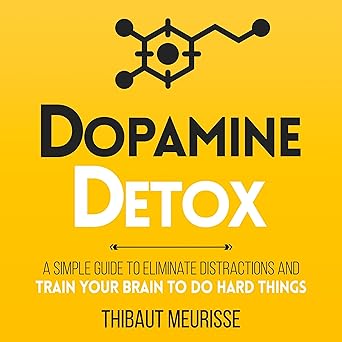
In a world full of pings, buzzes, screens, and endless digital stimulation, our attention is the battlefield — and many of us are losing the war. Dopamine Detox by Thibaut Meurisse has emerged in recent years as a short, practical self-help guide aimed at helping readers regain control of their attention, motivation, and life in the age of distraction.
Whether you’re a student battling procrastination, a professional struggling with focus, a parent concerned about digital habits, or simply someone who wants to live a more intentional and productive life,this book poses a compelling question: What happens when we reset our brain’s reward system? Amazon
In this article, we’ll explore why reading Dopamine Detox is worth your time, what the core ideas are, how it differs from other self-help books, and what you’ll gain — both intellectually and practically — from its insights.
1. Understanding the Context: Why This Book Matters Today
We live in an era of constant stimulation:
- Social media feeds refresh automatically.
- Videos are recommended endlessly.
- Notifications interrupt our focus.
- Boredom feels intolerable.
All of these phenomena aren’t random — they are engineered to hijack our attention and keep us engaged for as long as possible. This state creates a cycle where quick hits of pleasure are constantly sought after but lasting satisfaction remains elusive.
Thibaut Meurisse’s Dopamine Detox positions itself as a response to this state of overstimulation. The book warns that modern life may be rewiring us toward instant gratification, distraction, and short-term pleasure at the expense of deeper fulfillment. Amazon
While the title might sound scientific — and at times even catchy — the core premise is practical: our attention, habits, and behaviors have been shaped by reward systems that favor immediate reward over long-term goals. The book seeks to help readers identify those systems and make conscious changes.
2. What Is Dopamine — Really? A Simplified Explanation
Before exploring why the book is valuable, it’s essential to understand its central concept — dopamine.
Not Just a “Feel-Good Chemical”
Contrary to popular belief, dopamine isn’t simply the brain’s “pleasure chemical.” Meurisse explains that dopamine is more accurately tied to motivation, anticipation, and the pursuit of rewards, rather than the enjoyment of them alone. Amazon
In everyday life, this means:
- The thought of watching a video triggers dopamine.
- The expectation of a like on social media spikes dopamine.
- The anticipation of sugar, entertainment, or novelty keeps us engaged.
Dopamine drives us to seek rewards — not necessarily to enjoy them once they arrive. This nuance is important because it explains why short, easy pleasures can hijack our focus and motivation.
3. The Problem: Overstimulation in Modern Life
In Dopamine Detox, Meurisse argues that many of today’s digital and lifestyle habits lead to what might be called dopamine overload. Constant exposure to notifications, binge-watching, endless social feeds, and other high-stimulus activities keep our brains in a loop of quick and often shallow satisfaction. Upstox – Online Stock and Share Trading
This overstimulation can manifest in several ways:
- Reduced Attention Span: We find it hard to focus on difficult or prolonged tasks.
- Procrastination: We put off meaningful work in favor of quick dopamine hits.
- Loss of Patience: We crave instant results and feel frustrated when deep work takes effort.
The book invites readers to step back and evaluate where their time and attention go — not just how much time they spend online, but how that time affects their ability to think deeply, work meaningfully, and live intentionally.
4. What a “Dopamine Detox” Actually Is
You cannot detox from dopamine itself — it’s a naturally occurring neurotransmitter essential for many brain functions. But Meurisse uses the term metaphorically to describe a practice of limiting exposure to high-stimulus activities so that the brain can reset its reward sensitivities and priorities.
The Concept Simplified:
- Reduce: Temporarily cut out or significantly limit activities that give immediate, shallow reward (e.g., social media, mindless browsing, binge-watching).
- Replace: Use that freed-up attention for meaningful and constructive activities (e.g., reading, walking, creative work, reflection).
- Recalibrate: Over time, rewire your brain to find joy and satisfaction in longer-term, deeper pursuits rather than quick hits. Vocal
In practice, the detox may involve something as simple as a 24-hour break from social media and similar distractions, or it might be an ongoing effort to minimize reliance on digital stimuli.
5. Major Themes the Book Explores
Dopamine Detox isn’t just about avoidance — it’s about intentional living.
A. Focus and Deep Work
The book connects overstimulation with a loss of focus. When the brain becomes accustomed to easy rewards, it becomes harder to engage in tasks that require extended attention — like studying, writing, or meaningful work. Amazon
By reducing distractions, you are giving yourself the chance to develop sustained focus, which is foundational to productivity and achievement.
B.The Cost of Instant Gratification
It’s easy to fall into the trap of thinking that what feels good now is good for you long-term. Meurisse challenges this by showing how instant gratification can undermine patience and ambition.
The book encourages readers to rethink how they seek pleasure and success:
- Replace constant social media checks with purposeful breaks.
- Trade binge-watching for reading or physical activity.
- Prioritize tasks that build skills and long-term achievement.
This shift — from pleasure focused to purpose focused — is one of the core philosophical messages of the book.
C.Habit and Self-Discipline
Another theme is the connection between dopamine triggers and habit formation. By learning to control your impulses and build intentional habits, you can strengthen your self-discipline — and that, in turn, supports your larger goals. Amazon
This isn’t about rigid asceticism. Instead, it’s about creating boundaries and routines that protect your attention while allowing you to engage in meaningful work.
D.Embracing Discomfort
One of Meurisse’s key points is that discomfort isn’t a sign of failure — it’s part of growth. When we remove the easy escapes (like scrolling endlessly or snacking for dopamine boosts), we often face boredom or restlessness. Yet, this discomfort can be transformed into opportunity: it’s the space where focus, resilience, and steadiness are cultivated. Brajti
6. What You Will Learn From This Book
While the Dopamine Detox is relatively short compared to many self-help books, it’s designed to be practical and action-oriented. Here’s what readers often take away:
I. How to Identify Your Dopamine Triggers
The book helps you pinpoint the activities that feed distraction and interfere with focus — from social media to random web browsing, endless notifications, and more. This self-awareness is foundational because you can’t change what you haven’t noticed. Amazon
II. How to Set Up Your Own Detox Plan
Instead of generic advice, Meurisse walks readers through designing a detox plan that fits their life — from short resets to longer commitments. You don’t have to quit everything at once; you can start small and build momentum. Vocal
III. How to Replace Poor Habits With Better Ones
Detoxing isn’t just about removal; it’s also about replacement. The book suggests alternative activities — like reading, mindful walking, journaling, or creative hobbies — that may provide slower but more meaningful reward. Vocal
IV. How to Strengthen Self-Discipline and Focus
By reducing instant gratification triggers, you create space to engage in deep work and long-term tasks, which builds discipline over time. Amazon
7. Practical Benefits of Reading This Book
Here’s what many readers report gaining after applying the ideas from Dopamine Detox:
1. Improved Focus and Productivity
With fewer distractions, you can concentrate longer and work more deeply on tasks that matter. Shortform
2. Better Emotional Regulation and Patience
By resisting constant instant gratification, many readers find they react more calmly to delays or boredom.
3. Rediscovery of Simple Joys
When the brain isn’t constantly chasing dopamine spikes, simple activities — reading a book, spending time with loved ones, walking outdoors — become more satisfying. Amazon
4. Greater Self-Awareness and Control
Recognizing your triggers and habits puts you back in the driver’s seat of your attention and choices, rather than letting technology or impulse dictate your time.
5. A Foundation for Long-Term Success
By rewiring your reward responses and embracing focus, you’re better equipped to pursue long-term goals — whether professional, educational, or personal — with clarity and purpose. Amazon
8. Style and Accessibility: What Makes This Book Different
A common praise for Dopamine Detox is its simplicity and accessibility. Unlike many self-help books that are long, theoretical, or jargon-heavy, Meurisse writes in clear, actionable language with short chapters that are easy to read and apply.
This makes the book ideal for busy readers who want practical advice without excessive theory.
9. Who Will Benefit Most From This Book
Dopamine Detox isn’t a universal cure — but it’s especially helpful for:
- Students struggling with distraction and procrastination.
- Professionals seeking to increase focus and productivity.
- People overwhelmed by digital life who want more balance.
- Anyone feeling stuck in shallow habits and wanting to reset priorities.
Because of its accessible style and actionable advice, many readers find it a good starting point for deeper self-development work. Amazon
10. Criticisms and Balanced Perspective
No book is perfect, and Dopamine Detox has its critics.
I. The Scientific Argument Is Simplified
Some reviewers point out — including voices outside the book — that the term “dopamine detox” is not a clinical neuroscientific concept. Dopamine isn’t actually detoxified like a toxin, and the term is more metaphorical than literal.
Nevertheless, the behavioral principles behind the practice are useful, even if the wording is more popular psychology than neuroscience.
II. Some Readers Expect More Depth
Because the book is short and focuses on practice, some readers hoping for deep scientific or philosophical exploration may find it less satisfying. Amazon
III. It Requires Active Engagement
This isn’t a book you read passively — to benefit from it, you need to apply its advice consciously. But for many, that’s also its biggest strength.
Final Thoughts: Why You Should Read It
Dopamine Detox isn’t just another trendy self-help book. It speaks to a real problem many of us face: losing control of our attention and habits in a world built for distraction. What sets it apart is:
- Practical strategies you can implement immediately. Amazon
- Accessible language and actionable steps.
- Focus on mindset and environment, not just willpower.
- Relevance across ages, careers, and lifestyles. Amazon
This book can serve as a wake-up call, helping you reclaim your attention and align your actions with your long-term goals. Whether you want to become more productive, enjoy life more fully, or simply reduce the endless pull of digital distractions, Dopamine Detox offers practical guidance toward a more intentional, focused, and fulfilling life.
Dopamine Detox by Thibaut Meurisse – Chapter-by-Chapter Summary
Introduction: Why You Feel Unmotivated and Distracted
Thibaut Meurisse opens the book by addressing a common modern problem:
We are busier than ever, yet less focused and less fulfilled.
He explains that constant stimulation (social media, notifications, junk food, entertainment) keeps our brains addicted to instant rewards. As a result:
- Deep work feels painful
- Boredom feels unbearable
- Long-term goals feel exhausting
The solution, he proposes, is training the brain to tolerate boredom and effort again.
Chapter 1: What Dopamine Really Is
This chapter clears the biggest misunderstanding.
Key Insight:
Dopamine is not pleasure, it is motivation and anticipation.
- Dopamine spikes before an action (scrolling, eating junk food)
- Not after satisfaction
- This is why cravings are stronger than enjoyment
Modern apps exploit this mechanism by keeping us in a loop of anticipation.
Takeaway:
If you control dopamine triggers, you control your behavior.
Chapter 2: The Dopamine Trap
Here, Meurisse explains how we unknowingly fall into a cycle:
- Easy pleasure
- Reduced motivation
- Need for more stimulation
- Less satisfaction
Examples of dopamine traps:
- Social media scrolling
- Pornography
- Video games
- Junk food
- Endless YouTube or reels
These activities:
- Require zero effort
- Provide instant reward
- Destroy patience and focus
Takeaway:
The easier the reward, the weaker your discipline becomes.
Chapter 3: Why Hard Things Feel So Hard
This chapter connects dopamine addiction to procrastination.
Because your brain is used to easy pleasure:
- Reading feels boring
- Studying feels painful
- Working feels exhausting
Your brain resists effort because it expects instant rewards.
Important Lesson:
“The problem is not laziness, it is overstimulation.”
Takeaway:
Reduce stimulation → effort becomes tolerable again.
Chapter 4: What Is a Dopamine Detox?
Meurisse clarifies that a dopamine detox is not removing dopamine itself.
Instead, it means:
- Removing high-dopamine, low-effort activities
- Reintroducing low-dopamine, high-value activities
Examples of detox activities:
- No social media
- No junk food
- No mindless entertainment
- No multitasking
The goal is resetting sensitivity, not punishment.
Takeaway:
Temporary restriction leads to long-term freedom.
Chapter 5: How to Do a Dopamine Detox (Step-by-Step)
This chapter is practical and actionable.
Steps:
- Identify your biggest distractions
- Decide detox duration (24 hours to several days)
- Remove temptations from your environment
- Replace with meaningful activities
Replacement ideas:
- Reading
- Journaling
- Walking
- Planning goals
- Deep work
Key Rule:
Never detox without replacement.
Chapter 6: The Power of Boredom
This is one of the most powerful chapters.
Meurisse explains:
- Creativity is born in boredom
- Focus improves when stimulation reduces
- Mental clarity emerges when silence is allowed
Boredom is not a problem — it is training.
Takeaway:
Learning to sit with boredom builds mental strength.
Chapter 7: Building Long-Term Discipline
Detox is not a one-time event.
You must:
- Create rules for technology use
- Set boundaries for entertainment
- Choose effort over comfort regularly
Examples:
- No phone before work
- Reading before social media
- Work before entertainment
Takeaway:
Discipline is a muscle built through repeated discomfort.
Chapter 8: Living a Focused Life
In the final chapter, Meurisse emphasizes that dopamine control leads to:
- Better focus
- Stronger motivation
- Deeper satisfaction
- Meaningful achievements
He encourages readers to design their life intentionally, not reactively.
Final Message:
“You don’t need more motivation.
You need fewer distractions.”
7-Day Dopamine Detox Plan (Beginner Friendly)
This plan is perfect for students, professionals, and content creators.
Day 1: Awareness Day
✅ Track your habits:
- Screen time
- Social media usage
- Entertainment hours
❌ No changes yet
🎯 Goal: Awareness
Day 2: Remove One Major Distraction
Choose ONE:
- YouTube
- Reels
- Gaming
Delete app or block for 24 hours.
🎯 Goal: First resistance training
Day 3: No Instant Entertainment
Rules:
- No reels, shorts, or binge watching
- Music allowed only while working
Replacement:
- Reading
- Walking
- Writing
🎯 Goal: Rewire reward expectation
Day 4: Deep Work Day
- 2–3 hours of focused work
- No phone nearby
- Single task only
🎯 Goal: Experience deep focus again
Day 5: Dopamine-Free Evening
From 6 PM:
- No phone
- No TV
- No junk food
Activities:
- Journaling
- Planning
- Talking with family
- Reading
🎯 Goal: Calm nervous system
Day 6: Full Mini Detox
Rules:
- No social media
- No junk food
- No mindless entertainment
Allowed:
- Work
- Reading
- Walking
- Writing
🎯 Goal: Reset dopamine baseline
Day 7: Reflection & System Design
Write answers:
- What felt difficult?
- What felt peaceful?
- What habits will I keep?
Create new rules, for example:
- Social media only 30 minutes/day
- Work before entertainment
- Phone-free mornings
🎯 Goal: Long-term lifestyle change
Final Takeaway
Dopamine Detox is not about extreme discipline.
It is about regaining control over your attention, which is the most valuable asset in today’s world.
If you apply even 30% of this book, you will:
- Improve focus
- Reduce procrastination
- Feel calmer and more motivated
- Make better long-term decisions